
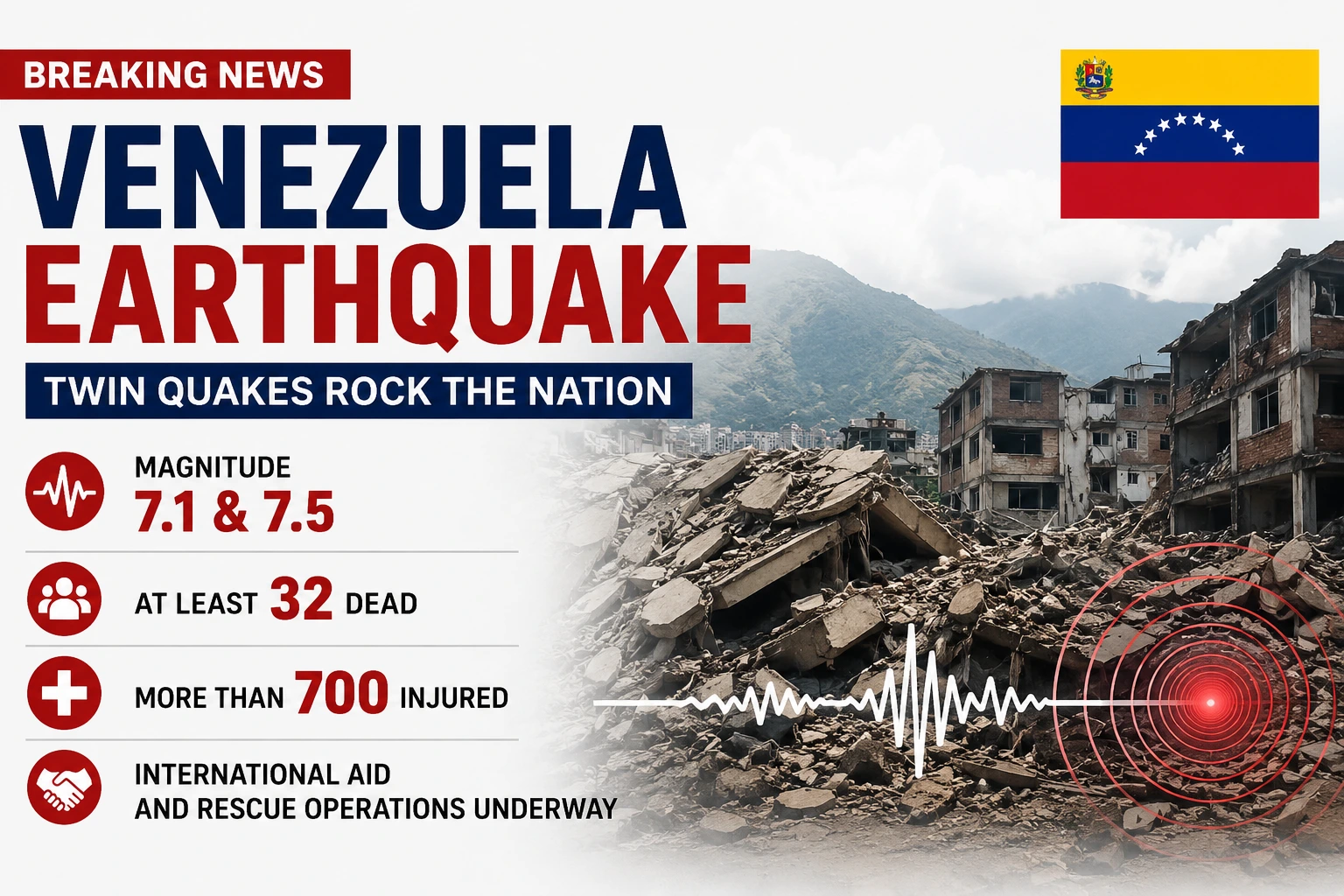
Caracas, June 25: Venezuela is facing one of its worst natural disasters in decades after two powerful earthquakes struck the country within a minute of each other, leaving at least 32 people dead and more than 700 injured. The rare back-to-back earthquakes, measuring 7.1 and 7.5 in magnitude, caused widespread destruction across the South American nation, forcing authorities to declare a state of emergency and launch large-scale rescue operations.
According to the United States Geological Survey (USGS), the first earthquake struck near the coastal region west of Morón at a depth of approximately 22 kilometers. Less than a minute later, a stronger 7.5-magnitude quake shook the same region, sending powerful tremors across Venezuela and neighboring countries.
Buildings Collapse Across Caracas
The capital city of Caracas witnessed scenes of panic as residents rushed out of homes, offices, shopping centers, and apartment buildings. Several structures suffered major damage, while some buildings partially collapsed. Dust clouds rose above parts of the city as walls crumbled and debris fell onto streets below.
Eyewitnesses described the shaking as one of the strongest they had ever experienced. Many residents spent hours outdoors, fearing aftershocks and additional building collapses.
Emergency services were immediately deployed across affected neighborhoods, where rescue teams worked through the night searching for survivors trapped beneath rubble.
Death Toll Expected to Rise
Acting President Delcy Rodríguez confirmed that at least 32 people had died and more than 700 others had been injured. Officials warned that casualty figures could increase as rescue workers continue operations in severely affected regions.
The coastal state of La Guaira has emerged as one of the worst-hit areas. Authorities reported significant structural damage to homes, businesses, and public infrastructure, leading some officials to describe parts of the region as a disaster zone.
Hospitals across the country have been placed on emergency footing, with medical personnel working around the clock to treat injured victims.
Read More:-iPhone 18 Pro: 7 Biggest Changes and Features Expected in Apple’s 2026 Flagship
Airport Closed, Schools Turned Into Shelters
The twin earthquakes caused extensive disruption to transportation networks. Venezuela’s main aviation hub, Simón Bolívar International Airport near Caracas, was temporarily closed after suffering structural damage.
Several roads were blocked by debris and fallen infrastructure, complicating rescue efforts. Power outages and communication disruptions were reported in multiple regions, leaving many families unable to contact loved ones.
The Ministry of Education suspended classes nationwide for several days. School buildings are now being used as emergency shelters, donation centers, and temporary accommodation for displaced families.
Tremors Felt Beyond Venezuela
The impact of the earthquakes extended far beyond Venezuela’s borders. Buildings were evacuated in several Brazilian cities, including parts of the Amazon region located more than 1,700 kilometers from Caracas.
Residents in Colombia also reported feeling strong tremors, though authorities there reported no major damage. Tsunami alerts were briefly issued after the earthquakes but were later lifted following further assessments by monitoring agencies.
International Community Offers Support
Countries from across the world have offered humanitarian assistance and emergency support to Venezuela.
The United States announced the deployment of search-and-rescue teams, medical resources, and humanitarian aid. Germany offered military transport aircraft to assist relief operations, while Spain prepared a specialized rescue unit equipped with trained search dogs and advanced detection equipment.
China, Brazil, Argentina, Mexico, Chile, Ecuador, Panama, Uruguay, and several other nations also expressed solidarity and pledged assistance to support recovery efforts.
Indian Prime Minister Narendra Modi expressed condolences and support for the Venezuelan people as world leaders reacted to the disaster.
Read More:-Messi Hat-Trick Fires Holders Argentina to Dominant Win Over Algeria at FIFA World Cup 2026
Communication Challenges Hamper Rescue Efforts
Communication disruptions have emerged as a major challenge following the disaster. Mobile networks and internet services experienced outages in several regions, making it difficult for families to locate relatives and access emergency information.
United Nations experts urged authorities to ensure uninterrupted access to communication platforms, emphasizing that timely information could be critical for rescue operations and public safety.
Why Are These Earthquakes Significant?
While Venezuela sits near several geological fault lines, earthquakes of this magnitude are relatively uncommon in the country compared to nations along the Pacific Ring of Fire such as Chile and Mexico.
Experts say the twin earthquakes rank among the strongest seismic events to strike Venezuela in more than a century, raising concerns about infrastructure resilience and disaster preparedness.
What Happens Next?
Rescue operations remain underway as emergency teams continue searching collapsed buildings and assisting affected communities. Authorities have warned residents to remain cautious as strong aftershocks remain possible in the coming days.
With thousands affected, major infrastructure damaged, and recovery efforts only beginning, Venezuela faces a long and difficult road to rebuilding after one of the most destructive earthquakes in its recent history.