
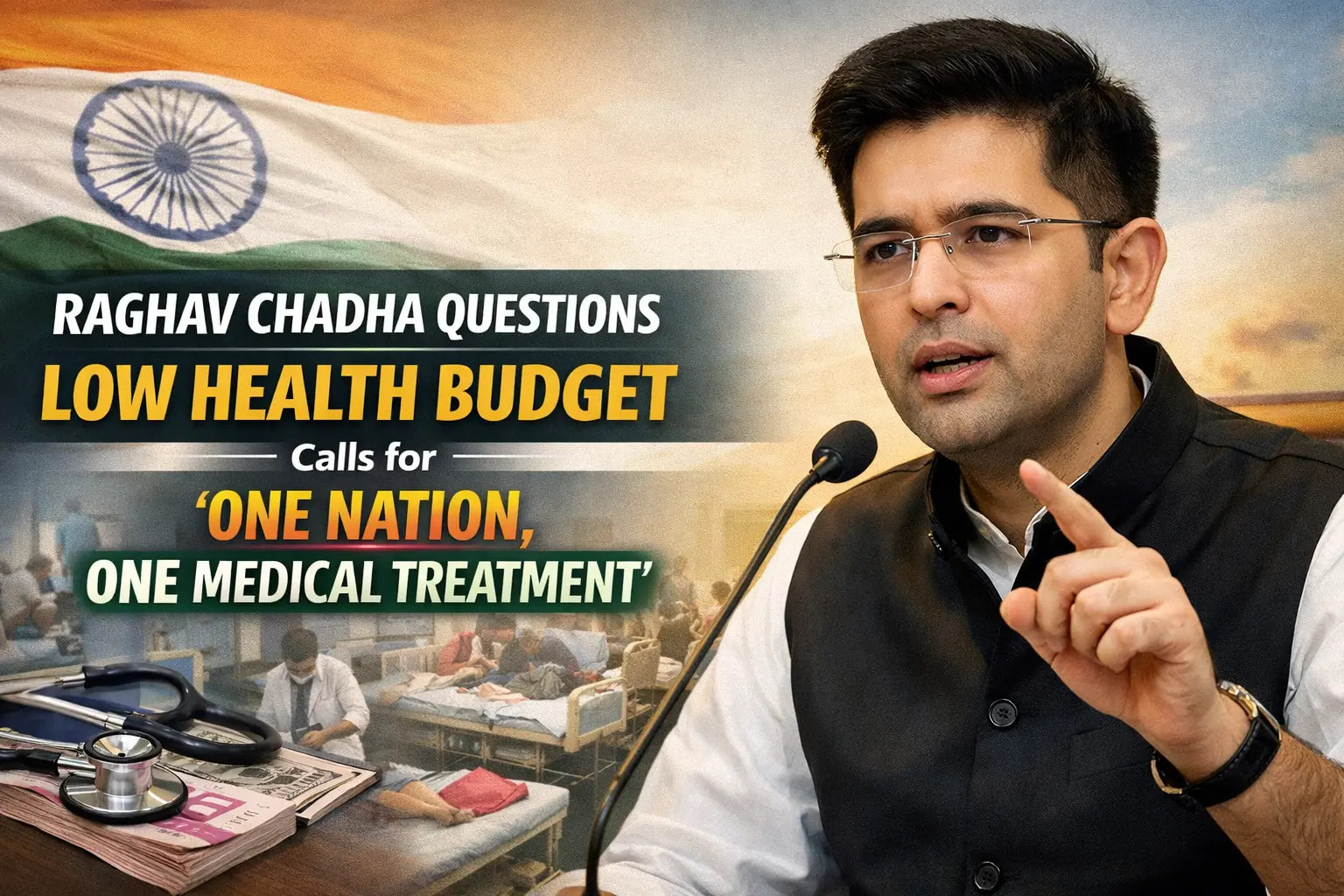
Raghav Chadha Questions Low Health Budget, Calls for ‘One Nation, One Medical Treatment’
New Delhi: Raghav Chadha, a Rajya Sabha MP, prompted new debate on India’s public healthcare goals by criticising the government’s allocation for the health sector in the Union Budget. Chadha stated in a recent post on X that India should progress toward a system that ensures equitable access to quality medical care, regardless of money or social status.
Chadha highlighted what he regarded as a structural imbalance in healthcare financing, stating that public health expenditure remains considerably below the objective established by the National Health Policy (NHP) 2017. The policy had envisioned increasing government health expenditures to 2.5% of GDP, but current estimates indicate that public spending remains much lower.
Health Budget Allocation Faces Fresh Scrutiny
Chadha remarked that healthcare constitutes only a modest portion of total government spending. While the Budget allocates significant sums to several sectors, he emphasised that investment in public health remained low in comparison to the size of India’s population and illness load.
He encouraged lawmakers to reconsider the allocation, arguing that healthcare should be viewed as a long-term national investment rather than a regular expense. According to Chadha, low funding directly contributes to the strain on public hospitals and frontline medical personnel.
Comparing Global Health Spending
Chadha emphasised the issue by drawing on worldwide analogies in his remarks. Developed economies such as the United States, the United Kingdom, and Germany devote a much larger proportion of their GDP to healthcare. Several European and East Asian countries also maintain higher levels of public health investment, indicating what Chadha called as a realisation of healthcare’s critical role in economic and social stability.
Challenges in Public Hospitals
The MP highlighted ongoing issues encountered by government hospitals, such as personnel shortages, insufficient bed capacity, and inadequate medical facilities. He claimed that overcrowded facilities frequently result in lengthier wait times, which can delay crucial treatments.
Read More:-Tata Punch EV Facelift Revealed — Updated Exterior Unveiled Ahead of 20 Feb Launch
“These systemic constraints disproportionately affect lower- and middle-income families who rely on public healthcare,” Chadha said, noting that many patients are forced to seek treatment in private institutions.
Financial Strain on Families
Chadha cautioned that excessive out-of-pocket costs in private healthcare can put households in financial trouble. He argued that a single medical emergency often results in enormous debt for families who do not have health insurance.
Call for Policy Reassessment
Chadha, using the phrase “One Nation, One Medical Treatment,” advocated for larger policy talks aimed at strengthening public healthcare systems, upgrading infrastructure, and extending affordable access to modern medical services.
His remarks have sparked debate among politicians and healthcare experts about whether India’s present level of health spending is adequate to tackle future challenges such as rising noncommunicable diseases, an ageing population, and public health catastrophes.
Disclaimer
This article is for informational purposes only. All product names, trademarks, and images belong to their respective owners. Any visuals used are for illustrative purposes and do not imply official endorsement or affiliation. If any content raises copyright concerns, it will be removed upon request.