
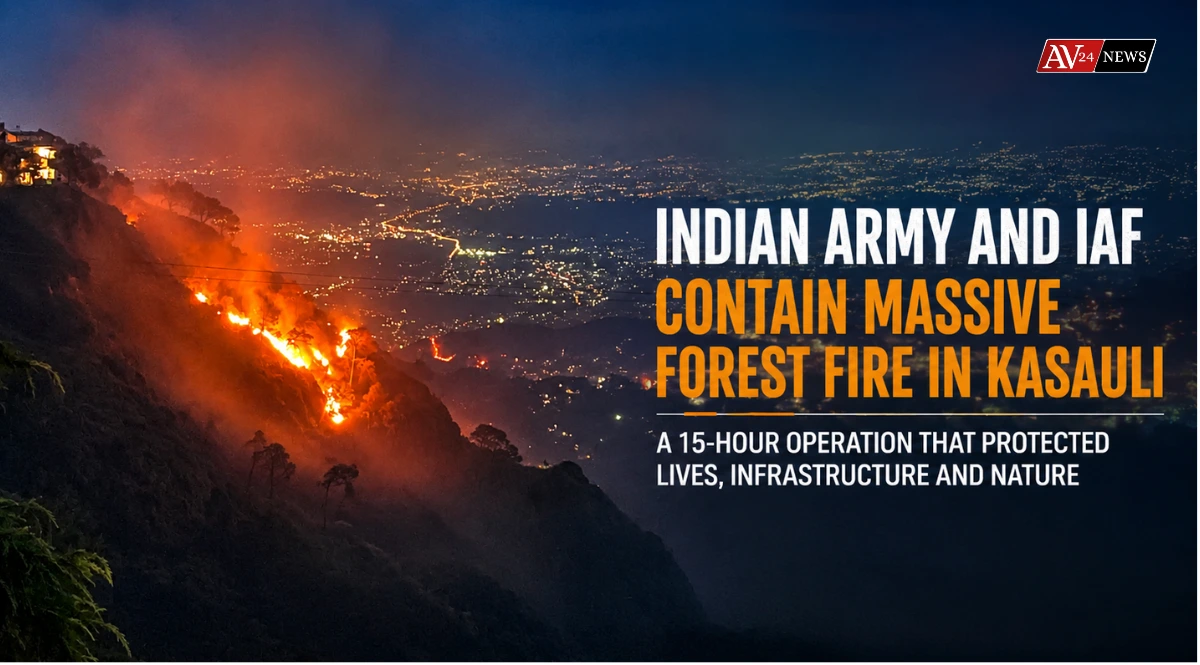
The Indian Army and the Indian Air Force (IAF) have successfully contained a massive forest fire in the popular hill station of Kasauli, Himachal Pradesh. The operation, which lasted over 15 hours, prevented the blaze from spreading to critical areas, including the local Air Force station and populated civilian zones.
The Timeline of the Crisis
The fire broke out on the afternoon of May 26, 2026, around 3:00 PM. Fanned by intense summer heat, strong mountain winds, and an abundance of highly flammable dry pine needles, the flames spread rapidly across the western slopes of Kasauli, specifically targeting the Gilbert Trail and Upper Mall areas.
As the fire grew in intensity and reached difficult, rugged terrain that local fire tenders could not access, the civil administration requested emergency military intervention.
A Coordinated Multi-Service Response
The situation demanded a dual-pronged approach, involving both ground and aerial combatants:
- Ground Operation: The Indian Army’s Kasauli Brigade mobilized both combatant and non-combatant troops. Working through the night, these personnel created critical firebreaks to isolate the fire and prevent it from jumping into deeper, vulnerable forest pockets.
- Aerial Assault: The IAF played a decisive role by deploying Mi-17 and Chinook helicopters. These aircraft executed multiple “Bambi Bucket” sorties—a specialized technique where a large collapsible bucket is suspended beneath the helicopter to lift and drop water. The choppers sourced water from Sukhna Lake in Chandigarh, nearly 30 km away, and were even equipped with night-vision gear to continue firefighting after sunset.
Read More: Heatwave Alert: 8 Districts of Himachal Pradesh Under High-Temperature Warning Today
Outcome and Safety
- No Casualties: Authorities have confirmed that there were no civilian or military injuries during the operation, and all equipment remained safe.
- Situation Stabilised: By the morning of May 27, the main fire zones were successfully contained. Army teams remain on the ground to monitor for any remaining “hotspots” to ensure the fire does not reignite.
- Recognition: Lieutenant General Pushpendra Singh, Army Commander of the Western Command, visited the site to assess the situation. He commended the troops for their professionalism and grit, awarding on-the-spot commendation cards to those leading the mission.
Why Kasauli is Vulnerable
The region, particularly in the Solan district, is heavily forested with chir pine trees. These trees shed resin-rich, dry needles that cover the forest floor, essentially creating a “tinderbox” that can ignite from even the smallest spark.