
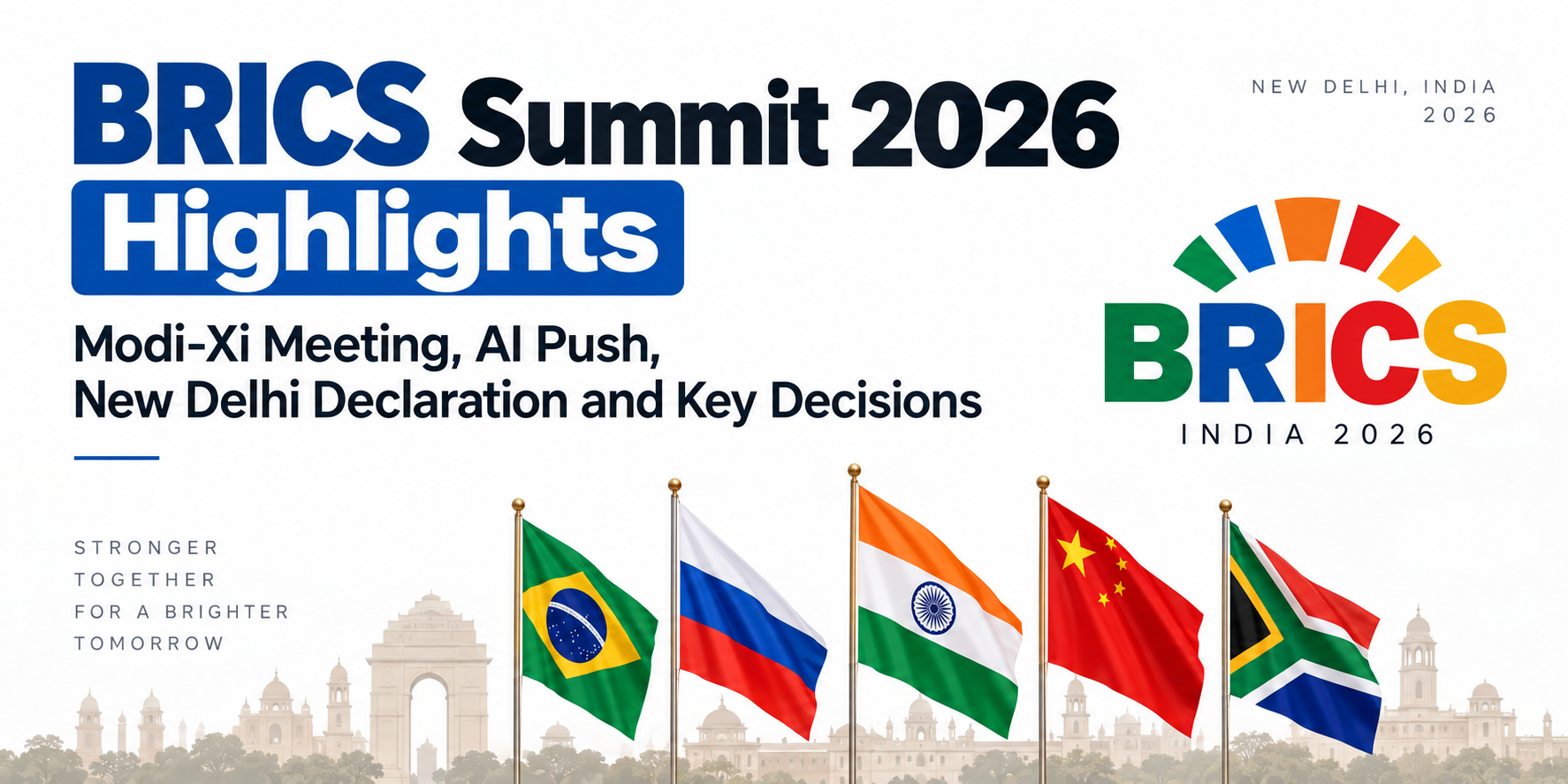
New Delhi, September 13, 2026 — The 18th BRICS Summit concluded in New Delhi with leaders adopting the New Delhi Declaration 2026 by consensus, marking one of the most closely watched diplomatic gatherings of the year. Hosted at Bharat Mandapam under India’s 2026 BRICS chairship, the two-day summit brought together Prime Minister Narendra Modi, Chinese President Xi Jinping, Russian President Vladimir Putin, Iranian President Masoud Pezeshkian, and other leaders of the expanded 11-member bloc at a moment of heightened global tension.
Here’s a complete breakdown of everything that happened — from the high-profile Modi-Xi meeting to the bloc’s first major push on artificial intelligence governance.
Key Facts at a Glance
- Event: 18th BRICS Summit
- Dates: September 12–13, 2026
- Venue: Bharat Mandapam, New Delhi
- Host & Chair: India, Prime Minister Narendra Modi
- Theme: “Building for Resilience, Innovation, Cooperation and Sustainability”
- Outcome: New Delhi Declaration 2026, adopted unanimously
- Attendees: Leaders from Brazil, Russia, India, China, South Africa, Egypt, Ethiopia, Indonesia, Iran, and the United Arab Emirates, plus partner countries and outreach invitees
Modi-Xi Meeting: A Diplomatic Highlight
Among the most closely tracked moments of the summit was the bilateral meeting between PM Modi and Chinese President Xi Jinping on the sidelines of the gathering. It marked Xi’s first visit to India in seven years and came amid a gradual thaw in Sino-Indian relations following years of tension after the Galwan border standoff.
In his closing remarks, Modi described India’s BRICS chairship as a “win-win collaboration” and touched on global supply chains, critical minerals, and the bloc’s role in a multipolar world. With Xi present, Modi cautioned against the “weaponisation” of technology and critical minerals, warning that such measures risk creating obstacles to shared growth.
Xi, for his part, called on BRICS nations to take on a greater peacemaking role amid the ongoing conflict in West Asia, saying instability in the region does not serve the common interests of the international community, and pledged that China would work with fellow BRICS members toward de-escalation.
Read more:-Apple Announces iPhone 17e at $599 (₹49,999) with Big Storage Upgrade
AI Push: Technology Takes Center Stage
One of the standout outcomes of BRICS Summit 2026 was the formal elevation of artificial intelligence into the bloc’s core agenda, alongside trade and finance.
Leaders committed to implementing the BRICS Leaders’ Statement on the Global Governance of Artificial Intelligence, referencing India’s AI Impact Summit held in February 2026 and the World AI Conference in Shanghai. The declaration calls for:
- Wider, more equitable access to AI resources and computing infrastructure for developing nations
- Development of trustworthy, safe, and inclusive AI systems
- Stronger international cooperation on AI applications across healthcare, education, finance, and energy systems
- Parallel commitments on cybersecurity and countering cross-border scam networks
- Prioritizing the interests of the Global South in shaping AI’s future development
This marks the first time AI governance has been embedded so explicitly into a BRICS joint declaration, reflecting the bloc’s ambition to shape global tech policy rather than simply react to it.
The New Delhi Declaration: What It Says
Spanning roughly 140 paragraphs, the New Delhi Declaration is one of the most extensive joint statements BRICS has produced. It was adopted after members overcame sharp differences — particularly between the UAE and Iran — over how to characterize the conflict in West Asia. Notably, the final text avoided directly naming the U.S. strikes on Iran or specific parties in the Gulf tensions.
Key Decisions From the Declaration
- UN and IMF Reform — Leaders reiterated support for reforming the UN Security Council and international financial institutions to make them more representative of the developing world, bolstering India’s long-standing push for permanent Security Council membership.
- West Asia and Gaza — The bloc called for maximum restraint, a Gaza ceasefire, protection of civilian infrastructure, and a long-term diplomatic resolution, while stopping short of naming specific aggressors.
- Terrorism — BRICS condemned terrorism “in all its forms,” explicitly referencing the 2025 Pahalgam attack in Jammu and Kashmir, and called for progress on the Comprehensive Convention on International Terrorism.
- Trade and De-dollarisation — The declaration criticized protectionist trade measures, secondary sanctions, and carbon border adjustment mechanisms (CBAMs), while advancing local-currency payment mechanisms among member states.
- Artificial Intelligence — As detailed above, AI governance was formally folded into BRICS’s strategic priorities.
- Sudan and Syria — Leaders expressed concern over the situation in Sudan and called for a Syrian-led political transition along with the withdrawal of occupying forces.
- Lebanon — The bloc welcomed the Lebanon ceasefire and condemned attacks on UN peacekeepers.
- Financial Cooperation — Increased support for the New Development Bank (NDB) and mechanisms to mobilize investment across member and partner economies.
- Health and Food Security — New initiatives aimed at improving agricultural resilience and strengthening health networks among member nations.
- Global Governance Roadmap — Modi proposed 10 formal proposals for reforming global governance structures, framed as the basis for a future “BRICS Reform Roadmap” rather than an immediately binding institutional change.
Read More:-Renault Duster Launched at ₹10.29 Lakh in India – Full Details, Features & Specs 2026
What BRICS Did Not Do
Analysts covering the summit have been careful to note the limits of what was actually achieved. BRICS did not launch a new common currency, did not replace or restructure the IMF or World Bank, and did not establish a new global financial order. Instead, the summit advanced incremental mechanisms — local-currency settlements, AI governance frameworks, and NDB-backed financing — that could gradually deepen cooperation among the group’s large emerging economies over time.
Why This Summit Matters
The 18th BRICS Summit came against a backdrop of rising geopolitical friction, including U.S. tariff threats against BRICS nations over what Washington has called “anti-American” policies, ongoing wars in Ukraine and the Middle East, and escalating U.S.-China tensions. Against this backdrop, India’s ability to broker a unanimous declaration — despite competing interests among members like Russia, China, Iran, and the UAE — was seen as a significant diplomatic achievement for Modi’s chairship.
With the summit concluded, attention now turns to how member states implement the AI governance commitments, local-currency payment systems, and the broader reform roadmap proposed during India’s presidency year.
Frequently Asked Questions
Q: What is the New Delhi Declaration 2026? A: It is the joint statement unanimously adopted by BRICS leaders at the 18th BRICS Summit, covering UN and IMF reform, West Asia tensions, terrorism, trade, AI governance, and Global South priorities.
Q: Did Modi and Xi Jinping meet at the BRICS Summit 2026? A: Yes. The two leaders held a bilateral meeting on the sidelines of the summit — Xi’s first visit to India in seven years — focused on trade, technology, and bilateral relations.
Q: What did BRICS decide on artificial intelligence? A: Leaders committed to implementing the BRICS Leaders’ Statement on the Global Governance of Artificial Intelligence, emphasizing equitable access, trustworthy AI systems, and cooperation across healthcare, education, finance, and energy.
Q: Where was the BRICS Summit 2026 held? A: The summit was held at Bharat Mandapam in New Delhi, India, on September 12–13, 2026, under India’s BRICS chairship.
This article is based on official summit proceedings and reporting from multiple news sources as of September 13–14, 2026.